

« There is no SIDE to music for me. »

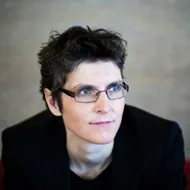
Elisabeth Fuchs is Chief Conductor of the Philharmonie Salzburg and maintains a busy collaboration with renowned orchestras such as the Stuttgarter Philharmoniker. The Austrian-born conductor studied orchestral conducting, oboe, school music and mathematics at the Mozarteum Salzburg, the Paris-Lodron-Universität Salzburg and the Musikhochschule Köln. Elisabeth Fuchs loves breaking musical boundaries. This has led to special collaborations with Stjepan Hauser (2Cellos), the David Orlowsky Trio, the Klazz Brothers, Rolando Villazón, Iris Berben and many other artists. A great concern of hers is participatory music education, which leads, among other things, to choir projects with over 300 participants as well as intensive work with children and young people.
In the following interview, Elisabeth Fuchs talks about her crossover projects, the long-term vision of the Philharmonie Salzburg and her great role model.
Classicpoint.net: What are your earliest musical memories?
When I was 4 years old, the Kaiserwalzer, played by my mother on the piano. I also remember hearing 'Eine kleine Nachtmusik' as a child, and I loved it immediately and sang along. The melody of 'Weißt du, wieviel Sternlein stehen' also immediately comes to mind; by the way, I had my first experience as a rehearsal pianist at the age of five: me on the recorder, my mother on the piano.
You studied oboe before taking conducting lessons. Did an instrumental career ever become a topic?
A solo career on an instrument was not a serious topic, no. But, to let you in on a secret: the daring idea of a singing career did come up once, though only very briefly.
You enjoy breaking musical boundaries too. Can you tell us about your performance and acrobatics projects?
In life and in all my projects, I seek encounters with wonderful people and artists. I am interested in what they do, what moves them, where we are alike and where we differ. That is why it is only logical for me to break down the boundaries between genres. Alongside music and sport, I have always found the other fields such as dance and acrobatics, directing, acting and literature, or architecture, visual arts and film, inspiring. I am a curious type, but of course life is too short to grasp all the questions of religion, psychology, world history and politics, or physics in their entirety.
I make the most of my time as best I can, and that is also one reason why my artistic work includes many crossover projects. I love complexity and variety when they have depth. It's all or nothing. In 2018 we rented an arena and invited acrobats and BMX riders onto our stage; it was a huge success, a next level. In 2019 we entered a new dimension with the actor Philipp Hochmair and his 'Jedermann reloaded', for which we created a symphonic version. Yes, we are bold and eager to experiment. We are fortunate, because our audiences enthusiastically go along with us.
You want to convey music by involving people. Could you also present your projects in this area?
Music is a great source of inspiration for me. I want to pass this on to my audience and above all to young people. We design our children's festivals and our school and apprentice concerts creatively, in a way that is close to the audience and sustainable. We convey classical music in an age-appropriate and captivating way. Open ears are curious, and participation is for them a natural approach to understanding music.
In short, there are two aspects of participation in my projects. One is participating during a concert, as for example at our education concerts, where the audience has parts to join in. Singing, dancing, body percussion, making music together – we have enjoyed great success with this for many years.
Much newer is the choir of the Philharmonie Salzburg, which I founded and which invites enthusiastic choristers to take part in choir-orchestra projects. The response is enormous. For example, for Carmina Burana at the Salzburg Felsenreitschule we had over 400 singers on stage with us; for operas it is 250 singers, and for Beethoven's Ninth over 350. I think far more should be sung together in general.
You have had various conducting teachers. Who taught you the most?
I think every teacher, male or female, has given me a great deal. Without encounters with great role models, one learns nothing about oneself and the chosen profession. I wish for every person that they meet the right masters in their life. For me, learning has never stopped; it continues steadily. That is wonderful!
One of my greatest role models is my mother. She was an innkeeper and head cook. I learned what management means from her, while helping in the kitchen and in the dining room. That, and her exemplary will to persevere, have shaped and enriched my life.
Can you describe the sound ideal you aim for with your orchestra?
For me, a sound ideal is a yes to the great whole. When ALL of them share one breath, one phrase and one sound concept. And to bring out the sound itself in all its colours, from 'utterly dejected' to 'jubilant rejoicing'. As differentiated as possible. This applies to life and to music.
My orchestra, the Philharmonie Salzburg, is unbureaucratic and open. We work in agile structures, support young musicians, and love both classical music and crossover. A sound ideal in the figurative sense also arises when the atmosphere in the hall is right, between me, the musicians and the audience.
You are still young. What goals are you setting yourself for the future?
My goal in life was and is to seize the opportunities that arise and that suit me. That is how I want to walk my path, in the hope that my good ideas will not run out. Perhaps my goals are my visions. Then a home of our own for my orchestra here in Salzburg would be a great goal, for rehearsals and for small concerts and workshops.
What interests you besides music?
There is no SIDE to music for me, because I understand my life as 'being in flow'. Music plays a major role in every fibre of my being. But if you ask me what else is important to me, it is people. Naturally my family, my children and my friends.
Interview by Florian Schär | Classicpoint.net | 2.03.2020
Photo: © Erika Mayer
More interviews
All interviews →


