

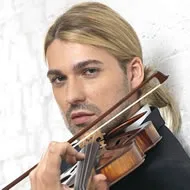
«Today I enjoy life.»

David Garrett has become famous far beyond classical music with his crossover music. Nevertheless, 70–80% of his concerts are still classical. At the age of thirteen, he became the youngest artist ever to receive an exclusive contract with Deutsche Grammophon Gesellschaft. Yehudi Menuhin described him as the “greatest violinist of his generation”.
Classicpoint.ch: Looking back today, how do you view your childhood, when social contact was barely permitted and any music other than classical was frowned upon and forbidden?
As a teenager, I hated the discipline and resented the lack of freedom. Today I see it as a blessing in disguise and simply enjoy life.
At 18, you broke away from home to study at the Juilliard School in New York. What was decisive in enabling you to leave home?
I have always loved New York, but the decisive factor for me was the opportunity to study with Itzhak Perlman.
What is your relationship with your parents today?
I see them rarely, as I am always on the road. But we see each other when I am in Germany.
If you discovered that your own child had enormous talent, how would you nurture their musical development?
I would let them follow their own path, but support every talent.
At the Juilliard School, you studied composition and music history. What motivated you to do so?
To understand all music, I believe one needs as much knowledge as possible. These studies have been of invaluable worth to me.
You won an internal composition competition at the school with the composition of a fugue in the style of Bach. Do you still compose today, or do you only write “arrangements”?
I still compose new pieces. Celtic Rondo is the latest piece I have written together with my musical director Franck. It is on my new album. Since I have Scottish roots, I wanted to give my music a Celtic influence.
What led you to start with crossover?
I always wanted to reach a broad range of listeners: from my friends, who would perhaps not normally listen to classical music, to children beginning to engage with music, through to older fans who value my musical roots.
Does it bother you that the classical world often reduces you to crossover music? After all, 70–80% of your concerts are purely classical?
Most classical musicians I know listen to contemporary music. Of course, some people in the classical world consider pop and rock music to be inferior. But all the great composers of the past, such as Beethoven and Bach, integrated the popular influences of their time into their music.
You are heavily criticised from many quarters. People accuse you of marketing yourself at any cost, etc. How do you deal with criticism, and whose opinions do you listen to?
Everyone has the right to their own opinion. To a certain extent, such opinions can also open up new perspectives. But everyone can decide for themselves what to make of them. The rest is a lot of hard work to get the most out of all the possibilities.
Interview by Florian Schär | Classicpoint.ch | 6.5.2013