

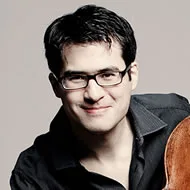
« Success means being yourself. »
Since winning the ARD Competition and the Grand Prix Emanuel Feuermann, Danjulo Ishizaka has been counted among the outstanding cellists of his generation. His distinctive tone colour and honest musical language testify to great maturity and a high degree of recognisability. Danjulo Ishizaka is a professor at the Hochschule für Musik "Carl Maria von Weber" in Dresden.
Your mother is German, your father Japanese. You grew up in Germany. What is Japanese about you?
Naturally, everyone has different ideas about what is Japanese. I carry a great deal within me that could be described as Japanese – there are certainly things I picked up directly from my father. For example, the will to see something through to the end once you have set yourself a goal, and to do so with a certain discipline and determination. Or certain traits in interpersonal dealings, e.g. that I don't use the word "No" as often or as directly – in Japan, in many situations, this short but potentially very strong word is hardly used. Whether my appearance is Japanese, everyone must decide for themselves – in Europe I am mostly taken for Japanese, and in Japan for European…
You began cello lessons at the age of 4. What are your memories of those early days? How did it come about?
Ever since I was able to think at all and consciously perceive things, music was among the things I had always heard. On the one hand, it was above all my older sister, who was already playing the piano and practising daily when I was born; on the other hand, there were gramophone recordings by a wide variety of artists and orchestras, but especially chamber music, which was played on every possible occasion. By the way, the Bach suites played by Pablo Casals were not missing either. In short, music had always been omnipresent throughout my childhood. So it seemed only logical that at a very young age I also came to learn the piano myself, taught by my mother. I have a clear memory from that time: my mother trained our absolute pitch using a "guess the note" game. I can still remember exactly the little footstool on which I sat behind the piano during this. Before long my mother felt that there should also be a cellist in the family, and of course I found it exciting to play something that was new in the family, so I approached it with corresponding enthusiasm. It soon became clear that my talent seemed made for the cello.
You studied with Boris Pergamenschikow in Berlin until his death in 2004. Can you tell us about your time as a student?
The time with Boris Pergamenschikow was the most important and formative period of my studies. For me he was not only a great role model, a brilliant teacher and, later, on several occasions a musical partner, but he also became a person I trusted, a genuine friend. I learned from him for life. His way of teaching and of working was deliberately holistic in shaping. He treated his students as equals, as colleagues. His manner of imparting knowledge was always subtle and often shaped by his very personal humour. His aim was always to expand the student's power of imagination, to broaden their horizons and to make their thinking more holistic.
You also maintained a close collaboration with Mstislav Rostropovich. What memories do you have of this personality?
For me, too, he was naturally the great father figure of all cellists. Playing under his direction and receiving lessons from him was like encountering a living legend. There was, of course, much that impressed me greatly about him, such as his engaging personality and his fearlessness, with which he was able to win people over not only on stage but also in interpersonal relationships. In addition, he had seemingly inexhaustible energy, which was expressed, among other things, in the fact that he managed with an absolute minimum of sleep. He once told me that in his youth, after his father died and his family was left to fend for itself, he sometimes worked through the nights to secure the family's livelihood. His life was simply filled to the utmost, and he did so much that others might manage in 140 years. Particularly impressive, however, was his ability always to follow his instinct and always to stand by his own principles.
Classical concerts have increasing difficulty filling halls. How do you view this problem?
Unfortunately, it is indeed the case that there is ever less interest in classical music, especially among younger generations. That is at least my subjective impression, even though I am not aware of statistics from recent decades. In my view, the problem is that our society is increasingly oriented towards consumption, and that relationships – not only with people – are becoming ever less binding, and that, in general, many young people are losing their connection to their inner self. To be able to get something out of classical music, one needs the will to engage with it, to learn, to understand, and also to let the effect of the music take hold. All of this stands in great contrast to what much of the young generation is characterised and shaped by. Classical music simply cannot be consumed casually; it is usually not "cool" enough. Naturally, this also raises questions for us classical musicians as to how we can counter this development. However, it would not be the right approach to place the responsibility for all of this on classical musicians alone; it is not enough to make the occasional school visit. Rather, it is above all a societal question of what we want for the coming generations, how they should grow up, and what the deeper causes of all our present problems are. Among other things, in my view we should also make our art and culture more accessible to a broader section of society, through a full integration into our current education system, on equal footing with the training of our left, that is, rational, hemisphere of the brain.
You play the Stradivari cello "Feuermann", formerly played by the legendary cellist Emanuel Feuermann, and the cello built by Wolfgang Schnabl, previously played by Boris Pergamenschikow. How do the two instruments differ?
The Feuermann is a very small cello; it dates from Stradivari's late period, and he built only 2 cellos in this format. It is above all very slender. This form was, in a sense, an experiment by Stradivari; he was searching for a form that would better meet the growing demands of solo playing. It was quite a readjustment for me, as previously I played the Stradivari "Lord Aylesford", a cello from 1696, from an early period of Stradivari's in which the cellos were very large.
The cello built by Wolfgang Schnabl is an exact replica of the Montagnana cello ex Konstantin Romanov, my teacher Boris Pergamenschikow's instrument. In its overall design it is quite different from the Feuermann: it has rapidly sloping ribs that are at the same time rounded, which results in a special form that reminds me of a bell.
In handling, the two instruments must be "approached" in entirely different ways. The Feuermann has a very strong will of its own and will not be "dictated to"; it would most like to simply sound however it pleases at the moment, and this can vary greatly depending on the weather conditions. However, one is rewarded with many special tone colours and a brilliance that is almost atypical for a cello, with a great many overtones, almost something violin-like. For certain works, such as Prokofiev's Sinfonia Concertante, I would, in terms of character, however prefer the Montagnana replica, as its character suits this piece much better. Furthermore, one can say of the Montagnana copy by Wolfgang Schnabl that it is simply a fabulous new instrument. The instrument is also very rich in colour and has plenty of power. It is a luxurious situation to be able to play on these two instruments, and the playing of each instrument is absolutely enriching for dealing with the other. The Feuermann cello is on loan from the Nippon Music Foundation, and the Montagnana copy by Schnabl is on loan from the Kronberg Academy. Do I own a cello of my own in addition? No!
You have won first prizes at important competitions. In your view, what is the key to success?
Of course, it depends on how one interprets the word success. For me, success is above all personal success, which does not necessarily go hand in hand with measuring oneself against others, such as how many concerts one plays with orchestras of a certain "class", etc., or how many competitions one has won. In my view, success means following one's own very personal path, doing what one burns for and loves, and not "bending" oneself for anything, that is, always remaining true to oneself. In other words, briefly and succinctly answered: success means being yourself. And anyone who sincerely tries this knows full well how difficult it can often be.
Competitions have of course opened many opportunities for me; in a sense, they have opened doors. But I have also quickly understood that one cannot sit back on the strength of competition successes and believe that everything will come to one – we live in the wrong era for that. Today, one is rather expected to be someone who is not only an excellent instrumentalist and artist, but who should also have the ability to express themselves eloquently about music in words, possess certain skills of a manager, at least some of the programming talent of an artistic director, and be so good at organising travel that one could immediately get a job in a travel agency. Perfect command of computer hardware is obligatory and taken for granted.
You teach as a professor at the Hochschule in Dresden and regularly give masterclasses. What is important to you when teaching?
When teaching, it is important to me that my students find their own musical truth and learn to fuse the intellectual knowledge they acquire about music during their studies, together with their intuition, into their own, very personal interpretation – so that they find, in a sense, their very own musical voice. This naturally includes many instrumental prerequisites, by which I mean above all the indispensable foundation of technique. Technique, like everything else, can always be refined further, but it is important that students learn to go through life with open senses for everything new and learn to put newly gained insights into practice for themselves.
The Hochschule für Musik in Dresden offers a very good location for students' training, of course: Dresden is a city of high cultural standing, with two outstanding orchestras, an incredible amount of cultural programming and a beautiful, historically rebuilt city centre. The Hochschule itself offers an inspiring environment and an outstanding faculty.
Apart from music, do you have other interests or passions?
There is something I have been doing for longer than playing music, and with passion: skiing. I also very much enjoy cycling, photography, and I feel very connected to nature, my love above all belongs to the mountains. Unfortunately, my calendar leaves less room for all of this than I would like. One thing, however, an activity that is for me even similarly creative to making music, I try to integrate regularly and naturally into everyday life: cooking. Improvised without a recipe book, of course.
What are your plans and visions for the future?
Naturally, there are many musical projects and ideas that I would most like to realise all of them. Of course, that will not be possible, but a great concern of mine is to bring composers and their works more into the focus of listeners, who, in my view, are far too rarely heard. This includes, for example, Zoltán Kodály, to whom I am currently dedicating a CD recording that is scheduled to be released this year. Further CDs are in planning. A truly lovely vision would also be finally to own a cello of my own, which will certainly not be easy, given the great competition in the form of the two loaned instruments I play.
Interview by Florian Schär | Classicpoint.net | 1 March 2017
More interviews
All interviews →


