

«Discipline and a great team.»
«Discipline and a great team.»
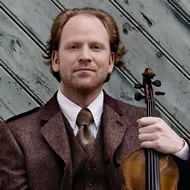
Daniel Hope is one of the most important violinists of his generation. At the age of 11 he already performed with Yehudi Menuhin. Alongside his solo career he was also a member of the Beaux Arts Trio. Daniel Hope is also an author and has already written two books.
Your mother was one of Yehudi Menuhin's secretaries. As a baby you were always present at rehearsals, concerts and tours. How did you experience Yehudi Menuhin as a child and teenager?
I came to his house at six months old. Until I was seven I spent almost every day with him, especially every summer in Gstaad. Later, at 16, I went on tour with him and for 10 years I played concerts with and under him: he conducted, I was the soloist, including at his last performance. It was a wonderful time; Menuhin was always warm and familial. He called himself my musical grandfather. Menuhin was very spontaneous. A Stradivarius or Guarneri always lay in its open violin case on the table; he never put them away. He would pick it up and play, without any great ceremony, as if he were drinking a glass of water. From him I learnt that one must play every day. He said: "You are like a bird, and can you imagine a bird saying, today I am tired, today I don't want to fly?"
What does Yehudi Menuhin mean to you as a musician and violinist?
"I now know that there is a God in heaven" was Albert Einstein's comment on Yehudi Menuhin's concert debut, which he gave at the age of seven in Berlin. Bruno Walter, the conductor of the evening, called him "the little boy with the great soul". Although Menuhin has been dead for a long time, I am constantly reminded of him. When I listen to recordings of him, I naturally think of his playing and his unmistakable sound. The intensity of the emotions he conveys to the listener is breathtaking.
Was there a key experience for you as a concertgoer of classical music?
I first heard the Mendelssohn Violin Concerto in E minor, Op. 64, with Pinchas Zukerman in London when I was five. From then on I was determined to play it, but technically I was nowhere near ready. At my boarding school I was frustrated because I was given too few pieces. One day I locked myself in the bathroom and secretly practised the violin concerto. I had got the score from a friend. I was caught and given a dressing-down. My parents were called; they thought I had set the school on fire. But when they heard what it was about, they took me out of the school.
Was there a key experience at a concert as a musician?
There are such experiences at almost every concert!
You played as violinist in the Beaux Arts Trio from 2002 to 2008. In your opinion, is there a particular Beaux Arts Trio sound that you had to seek out, or did you simply play in this trio the way you always play?
My time with the Beaux Arts Trio was a kind of chamber music specialisation. And what could be better than giving 400 concerts and recording three CDs together with the wonderful pianist Menahem Pressler? In those years I probably learnt more than at any other time in my life. At every rehearsal Pressler tried to reinvent the pieces, even if he had already played them several thousand times. There was not a single rehearsal of Beethoven's Archduke Trio in which he did not first pause for half a minute. For him it is always about life and death. He fights for every accent, and yet in ensemble he holds himself back so much. That is how magical moments arise. In the last formation of the trio with Pressler, the cellist Antonio Meneses and me, the chemistry was so good that in the end Pressler wanted the two of us to carry on the trio with another pianist. I could not do that. The Beaux Arts Trio is Menahem Pressler.
You are also an author. Your first book, "Familienstücke", became a bestseller in Germany. In it you describe the search for your great-grandparents in Berlin. Both were Jews living in Berlin who had converted to Christianity, and both of your great-grandfathers were murdered during the Holocaust. When and why did the idea arise to write a book about this?
In 2007 I received an offer to write my biography for the Rowohlt publishing house. I was flattered, but at the same time I found the request absurd at the age of around 30. So I declined with thanks. A few months later I was in Berlin and visited the former house of my great-grandparents. By chance I discovered something astonishing: my ancestors met one of the typical fates of that time. When the pressure on them became too great, they agreed to a forced sale of the villa and emigrated to South Africa. My great-grandfather did not endure the journey and died on the way there. At first the house continued to be used by the private Jewish Kaliski School; 39 pupils later lost their lives in the Shoah. From 1939 the Reich Foreign Ministry used the rooms. Here the Nazis' main decryption station was set up personally by Foreign Minister von Ribbentrop. Today the German Foreign Office still owns the house, and the German Archaeological Institute runs a guesthouse here. It is at once beautiful and sad to be in that house. On one of my first visits I discovered old pieces of furniture belonging to my ancestors there, and a family coat of arms. The story seemed very gripping to me, so I thought of the offer from Rowohlt and picked up the phone. That is how "Familienstücke" came about.
In September 2009 your second book appeared, a concert guide entitled "Wann darf ich klatschen?" (When May I Clap?). Why did you want to write this book, and for whom?
The book examines the so-called rules of classical music and its presentation. It asks why certain rules exist and how they came about. I wrote it because I did not know enough about it myself. The aim is to bring people to concerts by explaining things to them. This knowledge can no longer simply be assumed, now that home music-making and music education in schools have almost entirely disappeared. Someone at a reading of my first book once approached me and said he did not go to concerts because he did not know when to clap. So I simply began to study applause over five centuries...
You give over 100 concerts a year, record CDs, appear on television and write books that become bestsellers. How do you manage it all?
Discipline and a great team.
You are committed to ensuring that as many people as possible can get to know classical music. Which projects are especially close to your heart?
Live Music Now and Rhapsody in School are two outstanding projects that combine music and social engagement in an ideal way, and I take part in them regularly. I also direct two festivals (Mecklenburg-Vorpommern in Germany and Savannah in the USA), both of which have large-scale youth programmes or children's concerts.
You do not shy away from collaborating with musical styles beyond classical. What motivates you to create projects that combine classical with pop, rock, folk or techno?
I have not got much to do with techno, but with all the other genres I have. I find it exciting and inspiring to talk with musicians, to communicate with them and to learn from them. Genres play no role in that.
Most classical stars do not want to engage with other kinds of music. Do you think that is a good thing, or should there be a change of thinking?
Everyone has to find their own path. For me, being a musician means keeping your ears wide open.
Do you believe that classical music can move people more deeply than pop music?
Without doubt. Pop relates to classical music roughly as champagne relates to red wine. Champagne acts immediately, goes straight to the head, is tremendously effervescent, but only for a short time. The effect of a good red wine, by contrast, comes slowly, gradually, but lasts much longer. Champagne's taste is quickly forgotten, but you can still feel a fine wine on your tongue the next day, and sometimes you remember a very good vintage even months later.
Interview by Florian Schär | Classicpoint.ch | 04.05.2012
Photo: Harald Hoffmann / DG