

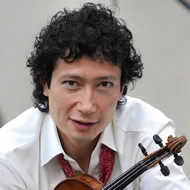
«If I am not focused, this violin tells me straight away.»
«If I am not focused, this violin tells me straight away.»
Dodds is an inspiring musical force. His enthusiasm and captivating energy on stage bring “joie de vivre” to fellow musicians and audiences alike.
Concerts have taken Daniel Dodds to major venues on every inhabited continent – as artistic director of the Festival Strings Lucerne, as a soloist with conductors such as Zubin Mehta, Vladimir Ashkenazy, Oksana Lyniv, Alexander Briger and Stanley Dodds, and as a chamber musician, documented in numerous live radio and TV recordings. The Hamburger Symphoniker, the Orchestra della Svizzera italiana, the Melbourne Symphony Orchestra, the Brisbane Symphony Orchestra, the Luzerner Sinfonieorchester, the Sophia Philharmonic Orchestra, the Australian World Orchestra and the Festival Strings Lucerne are among the orchestras with which Daniel Dodds has performed as a soloist.
You moved from Australia to Switzerland at the age of 17 to continue your violin studies. How did you experience this change?
Today I regard Switzerland as my home. I hold a Swiss passport, I am married to a Swiss woman, and although my two children hold Australian passports, they have grown up in Lucerne and are in many ways shaped by Switzerland. I feel at home here and appreciate much about this fantastic and fascinating country, above all the Swiss people. At 17, however, it was quite an adjustment. The weather, the culture, the manners – everything seemed different, like night and day. And then there was the language! Making direct contact with people seemed an almost impossible task back then. At some point I gave up trying to adapt in every last detail, and discovered that the best way to connect with the Swiss is a relaxed smile and a playful approach. And that attitude applies all over the world!
You are artistic director of the Festival Strings Lucerne. What sets this orchestra apart?
Recently the Festival Strings performed with the piano legend Maria João Pires in a purely Beethoven programme at the sold-out Megaron in Athens. The audience was beside itself with enthusiasm. What sets this orchestra apart? The audience that has heard the Strings live is probably best placed to answer that question. Since I was appointed artistic director 10 years ago, a culture of making music together has developed within the Strings that I believe is unique.
We love playing music at the highest level for audiences out of pure joy and enthusiasm. This effervescent joie de vivre is highly contagious to everyone in the hall, and is partly the reason why many outstanding soloists, such as most recently Maria João Pires, Midori, Hélène Grimaud, Rudolf Buchbinder or Khatia Buniatishvili, like to perform with us. I myself like to describe the Festival Strings Lucerne as “my absolute all-time favorite band!!!”.
Since 2008 you have been a member of the Lucerne Festival Orchestra and also perform as a chamber musician within this framework. How did this come about, and what is special about it for you?
Following a personal invitation from Claudio Abbado in 2008, I experienced wonderful concerts with the Festival Orchestra until his death in 2014. During this time I began working as artistic director of the Festival Strings, and soon it was no longer possible to take part in the Lucerne Festival Orchestra for scheduling reasons. In 2018 I was also invited to serve as concertmaster of the Australian World Orchestra, an orchestra assembled from the finest Australian musicians from around the world. Its members include principals, section leaders, principal wind players and concertmasters from the best orchestras in the world: the Berlin Philharmonic, the Vienna Philharmonic, Los Angeles, Chicago, Munich, London and many more. These projects offer a veritable “reunion” of friends and colleagues who come together from every corner of the world for a short and intensive period to play sold-out, highly acclaimed concerts in Australia, in England including the London Proms, in Asia, Singapore and India. These concerts are conducted by distinguished conductors such as Sir Simon Rattle, Zubin Mehta or Riccardo Muti. For me, performing with this orchestra is always a unique experience.
You also work as a soloist and have collaborated with renowned conductors such as Ashkenazy, Mehta, Abbado. Are there particular experiences or events that you remember especially well?
When Maestro Zubin Mehta first experienced me as concertmaster, he immediately invited me afterwards to perform as soloist, alongside the principal viola of the Vienna Philharmonic, in Mozart’s Sinfonia Concertante on a tour of India with the Australian World Orchestra. That is how quickly things can sometimes happen. Last September Zubin Mehta, after a serious illness, returned to Australia to conduct the Australian World Orchestra, probably for the last time. The programme included Richard Strauss’s “Ein Heldenleben”. He wished for me to play the famous concertmaster solo. At the applause, Zubin Mehta very humbly thanked me and said how special this Heldenleben was for him. Embarrassed, I mumbled something unintelligible. For it was I who had reason to thank him for being able to make music with such a legendary conductor.
You have also worked on crossover projects combining jazz, tango and Far Eastern music. What fascinates you about these projects?
It is the opportunity to work with wonderful and inspiring musicians from other styles that always draws me into such projects. There I can immerse myself in other worlds and exchange ideas with musicians from other genres.
You also teach violin and chamber music at the Lucerne University of Music. How would you describe your teaching style, and what is important to you in teaching?
I don't know whether I have a particular teaching style. For me, the focus in teaching is the student and his or her needs. These can vary greatly from person to person, depending on talent, ambition, development and so on.
What matters most to me is that young musicians find their own path and express themselves on their instrument in a natural way.
You play a Stradivarius from 1717. What is your relationship with this instrument?
I see it as both a privilege and a great responsibility to be able to play on this wonderful instrument. This violin is my tool of the trade; I use it to make music. At the same time, and perhaps even more importantly, it serves as a source of inspiration, both sonically and mentally, as a direct mirror of my imagination. What I dare to dream, the instrument returns without distortion, directly and without sentimentality. If I am not focused, this violin tells me straight away. But if I get carried away and a flood of inspiration overwhelms me, the sounds that come from it are pure poetry without words, perceptible to everyone. A miracle.
What other passions do you have besides music?
Apart from my work as artistic director of the Festival Strings, my many concert tours and teaching, there is not much time left for hobbies. I greatly enjoy spending time with my family and my closest circle of friends. One of my hobbies is Tae Kwon Do, in which I hold a black belt. Tae Kwon Do helps me recharge my batteries; I am surrounded by fellow practitioners in training who bring a dedication and passion to what they do that never fails to inspire and motivate me. That enthusiasm then flows back into the musical world in which I move.
Interview by Florian Schär | Classicpoint.net | 01.032.2023
Photo: Dorothee Falke