

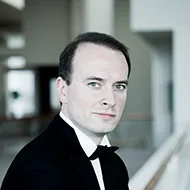
«I am no friend of the avant-garde, but of free tonality.»

The versatile singer and composer Daniel Behle is equally successful in concert, lieder and opera. His repertoire ranges from baroque masterpieces through classical and romantic repertoire to compositions of the 20th and 21st centuries.
He regularly performs with orchestras such as the Sächsische Staatskapelle Dresden, the Berliner and Wiener Philharmoniker, the Rundfunk-Sinfonieorchester Berlin, the Deutsches Symphonie-Orchester Berlin, the NDR Elbphilharmonie Orchester, Orchestra dell' Accademia Nazionale di Santa Cecilia, the Wiener Symphoniker, the Gewandhausorchester Leipzig and the Bachakademie Stuttgart, working with conductors such as Stefan Asbury, Bertrand de Billy, Semyon Bychkov, Christoph Eschenbach, James Gaffigan, Thomas Hengelbrock, Pablo Heras-Casado, Marek Janowski, Philippe Jordan, Fabio Luisi, Ingo Metzmacher, Kent Nagano, Yannick Nézet-Séguin, Hans-Christoph Rademann, Jérémie Rhorer, Andreas Spering, Christian Thielemann and Franz Welser-Möst.
You first studied music education, trombone and composition. What were your career prospects back then?
To be completely honest, I didn't give it any thought. I also don't believe that people study music because they want to earn money. Making music is a need and a drive. For me, at any rate. The only thing that had to be found was the outlet, and that took a while.
At the age of 22 you began singing lessons with your mother. What was it like being taught by your mother at that age?
Since I was already past puberty, lessons with my own mother were no problem. I experienced my mother as an artist, yes, as an extremely successful one worldwide. In this respect I already knew that what she taught me could possibly be of value. This determination threw me into the profession after six years of training. My first engagement was at the Theater Oldenburg.
Do you still play the trombone today?
Unfortunately not. I still have my alto and tenor trombones, but I don't play them. However, I write quite a lot for brass players, and currently, in my first stage work, I make sure, of course, that the colleague has something nice to play.
You then studied for five semesters with the tenor James Wagner and returned to your mother's singing class. Why the return?
James Wagner died suddenly in 2003. My studies were not yet complete. After his death I completed the second intermediate examination, the colloquium and the diploma within half a year. I did not want to subsidise my mother's job.
Are you still composing diligently?
In 2020/21 I finished my first stage work. An operetta, "Hopfen und Malz". With orchestra, chorus, eight soloists and a rather funny story. Composing and orchestrating two and a half hours of music was a monumental task. Now there are 600 pages of score, and I feel I have made optimal artistic use of the pandemic period.
What is important to you when composing?
I have always been a friend of the music-making. As an active musician, I was always very disappointed during my composition studies by how gladly and often one wrote against the musician. As you can hear, I am no friend of the avant-garde etc., but am very devoted to free tonality. A great admirer of Richard Strauss. His hypertonality, a term I coined for myself, the extremely rapid changes of tonal centres, gives me pleasure. It sounds beautiful, but you have to keep your mind on it. Demanding beauty, so to speak.
You received the Opus Klassik as Singer of the Year 2020. What does this award mean to you?
I still feel very honoured. I received the award as a label-independent artist. MoZart was my 14th solo album, which came about solely thanks to crowdfunding. A great thing.
How are you experiencing the current pandemic situation?
I have more time for my family and for composing. Planning and recording my own productions is only minimally affected by the pandemic. Switzerland supports self-employed artists during the pandemic. Lucky me.
What are you taking away from this time for the future?
Less flying, fewer lengthy new productions, and writing one more stage work. And, unfortunately, also realising that Germany, as a "land of culture", has not exactly covered itself in glory during the pandemic. Some of that will have to be made good.
What passions do you have outside of music?
My children, of course. And when there is time left over, I have been playing World of Warcraft for 16 years...
Interview by Florian Schär | Classicpoint.net | 1.6.2021
More interviews
All interviews →


