

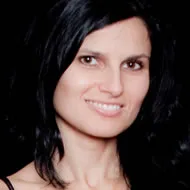
« Fate chose us as ambassadors. »
While still studying, in 1994 the Romanian violinist Corina Belcea founded a string quartet. As one of the first ensembles, the Belcea Quartet was invited to perform in the renowned BBC series «Radio 3 New Generation», and then things moved in quick succession: Carnegie Hall debut, Edinburgh Festival, Cologne, Amsterdam, Vienna Konzerthaus, a great career.
You founded the Belcea Quartet while still studying and gave it your name. Who took the initiative back then?
Actually, the quartet's first violist was a friend of mine from my time at the Yehudi Menuhin School. But after just a few months he decided to move more towards composition and left the quartet shortly before the first important competition. That was a decisive moment for the quartet, since we had to find a replacement in a very short time. Fate brought us Krzysztof, who was studying violin at the time. He told us that he really enjoyed chamber music but had never played viola. So he spent the following weeks learning the viola and the alto clef, which he didn't know either. His condition was that after the competition we would have to look for a proper violist to replace him. We then won the competition, and working together with him was so wonderful that we did not look for a replacement but instead convinced him that it was his calling to play viola with us. Today he still jokingly says that the quartet is still searching for a "proper" violist…
Since we needed a name for the competition, and all the good names were already taken, we named ourselves after my name, intending to change it as soon as we found a good name. We are still struggling with it.
You are married to the cellist in the quartet. Is that sometimes a strain on the collaboration or the dynamics within the group?
From my point of view, absolutely not, quite the opposite: I find working together with Antoine, sharing our musical and private lives, a wonderful gift, and I cannot imagine the quartet without him any more. Now that we also have small children, it is a blessing for me that on tour I have at least one family member close by, so that I can share the difficulties of constant travelling. Perhaps it is not quite so easy for the others, but if they sense it, they certainly don't complain!
How would you define your role within the string quartet, both musically and personally?
I see my role within the group as part of a whole. A string quartet is a unit made up of four different personalities, four minds that together form something special and unique. It is a mixture that keeps changing, because we are all constantly developing. Each of us has to contribute to the development of the group. That includes the musical side, the business side and the daily practice work. There is no doubt that each of us has strengths and weaknesses. What matters, however, is that together we can cover all the necessary areas. On a personal level, I believe that we are not just pursuing a job, but working out our destiny. We are very glad that we can do that together for the group. For all of us, chamber music is the most beautiful way of letting countless emotions communicate through music. It does not feel like work. I often think about how lucky we are to be allowed to do what we were born for. Well, we did choose this, and we could have learned another profession, but the truth is that fate chose us as "ambassadors". We are proud and feel privileged to be allowed to carry on this incredibly beautiful form of music-making as a tradition.
During rehearsals, do you have many disagreements that you have to resolve, or do you quickly find a compromise?
"Compromise" is a word we do not like to use in our work. It implies that nobody is truly convinced of it. We call it "finding another solution", a solution that is coherent, logical and faithful to the score. There are always discussions about how a phrase should be interpreted, what shapes the form, what character it should have. We often have different ideas. But we should be aware that music can sound wonderful in many different interpretations, and that debating a detail is wasted time. We try things out, and sometimes we notice that something simply doesn't work in concert. So we try to find new ways until we realise what fits and works. That is exactly the beauty of our work. It can have as many facets as a cut diamond throwing colours in the light.
Which of you is the most willing to compromise as a player?
We only make "compromises" on a human level, which means we are humble, patient, open to criticism and kind in our dealings with one another, so that we do not strain the fragile human relationships. Sometimes one has to temporarily give up something that is valuable to oneself, or change one's point of view. I think we are all stubborn to a certain degree, but we do our best to keep this as well under control as possible.
You also have two small children. Are they with you when you are on tour? How do you organise that?
It is a task that requires a great deal of planning and good management. Fortunately, my better half, the cellist Antoine, has these qualities in abundance. He organises the trips with our children astonishingly well. We try to take them with us as often as possible, because we feel so happy when our being together can be accommodated. Of course there are the usual moments of stress when you have to leave small children in the care of a complete stranger for babysitting, but so far our experiences have only been positive. The children are becoming more and more interested in our rehearsals, which is very important for their development and their connection to classical music. That can only be beneficial. The big challenge will certainly come when the children have to go to school. We are already looking for a solution, but we are waiting until the time comes.
There are quartets which, after many years of working together, can hardly speak to one another any more and want each member to stay in separate hotels. How do you avoid ever getting to that point?
The only way to make sure it does not come to that situation is to work on our relationships, just as in any marriage, only harder, because four people are involved. Many describe a string quartet as a bizarre marriage, and that is true to some extent. Many quartet musicians spend more time with their musician colleagues than with their spouses. That can lead to major conflicts, and I am not surprised that some need time alone on tour. Personally, I would find it very sad if our quartet ended that way, but for others it works well. Every group has its own dynamics, and each of us has to find out what suits him best.
Do you as a quartet also meet in your free time, that is, independently of rehearsals or concert appearances?
Until recently, three of us lived in the same building. There were natural and spontaneous meetings then. But now one member lives farther away, abroad. It is harder to spend time together outside working hours. On tour we try to do sightseeing together and enjoy the same restaurants.
You come from Romania. Are there things you sometimes miss from your homeland?
Above all I miss the people there, my family and my close friends. I used to travel to Timișoara more often, and I miss that. But since I also travel so much with the children, I physically need time at home without travelling. Emotionally I feel very much at home in Timișoara; this feeling of coming home is very strong whenever I land in Romania. This intense sense of belonging is only there when I touch Romanian soil.
There is currently a strong movement in Romania. People are taking to the streets in great numbers to demonstrate. How connected are you with your country of origin, and what do you think about this movement?
I am very happy and proud that my fellow citizens are taking up the challenge of changing the way our country is governed. For a long time our so-called politicians looked only at their own agenda and their own wallets. It is time for a fundamental correction, so that more decent people can move this beautiful and unhappy country forward, with its incredible people and remarkable potential. We need this change, and I deeply hope that people will not stop before it has been achieved.
Interview by Florian Schär | Classicpoint.net | 3 May 2017
More interviews
All interviews →


