

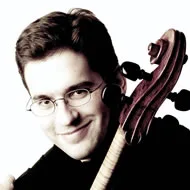
«Chamber music has always been central for me.»

Christian Poltéra, born in Zurich in 1977, has established himself internationally as a cellist. He performs both as a soloist and as a chamber musician. His discography features not the constantly performed cello concertos, but rather interesting compositions of the 20th century.
How would you describe your cello playing?
To describe my own playing, I lack the necessary distance and objectivity.
You studied for a long time with Heinrich Schiff, who also supported you greatly. How did you experience him as a teacher?
After lessons with my first teacher, Nancy Chumachenco, and a brief period of study with the far too early deceased Boris Pergamenschikow in Cologne, my studies with Heinrich Schiff in Salzburg and Vienna shaped me decisively. Hardly any other cellist of his stature has ever invested so much time, energy and patience in generations of students.
Do you also teach yourself?
Yes, since autumn 2011 I have been teaching a small number of students at the Lucerne University of Music.
Most soloists begin their careers by winning major competitions. In your case, it seems to be quite different. Did you deliberately choose a different path?
In order to make music inspired, I have to feel comfortable and be able to concentrate on the music. That feeling never arose for me in a competition situation. I am grateful that I never had to rely on competitions.
Why did you choose the Swedish label BIS for your CD recordings?
Nowadays, record labels that do not primarily aim for quick commercial success, but plan in the long term and build an artist patiently, have become rare. With BIS I can talk about musical content, and the recordings are produced with the greatest care and high quality standards.
So far you have mainly recorded pieces from the 20th century. Is this music of particular fascination to you?
A great deal of exciting repertoire for the cello was written in the 20th century. Mstislav Rostropovich alone commissioned over 100 cello concertos and premiered them himself! In addition there are important works by, for example, Martin, Martinů, Hindemith etc., which as a rule have been recorded comparatively rarely. Filling such gaps seemed to me, as a very young cellist, more meaningful and more pleasant than starting straight away with Haydn or Dvořák.
Will you also record the well-known and most frequently performed cello concertos, or will you remain true to your line of recording works that are rarely recorded?
In future it looks like a mixture of both.
You have formed a string trio with Frank Peter Zimmermann and Antoine Tamestit. How did this formation come about?
After a first collaboration in Mozart's Sinfonia concertante, Frank Peter was so enthusiastic about Antoine that he finally wanted to realise his long-cherished dream of a permanent string trio. I of course consider myself extremely fortunate that I then became the third member of the group! The intensive working phases, concert tours and CD recordings are by now absolute highlights for all three of us, musically and personally.
You emphasise that, alongside your solo activity, chamber music is also very important to you. Could you also imagine giving up solo work for a permanent string quartet or piano trio in order to devote yourself fully to chamber music?
Chamber music has always been central for me. At the same time, however, I do not want to forgo the sometimes exciting experiences of being a soloist with a large orchestra. I enjoy the contrast between these tasks.
Interview by Florian Schär | Classicpoint.ch | 01.03.2012
Photo: Marco Borggreve