

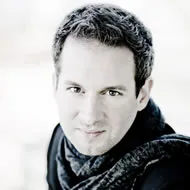
« We live in such an interesting time. »
Bertrand Chamayou, born in 1981 in Toulouse, was discovered at a young age by the pianist Jean-François Heisser as an outstanding talent and later taught at the Conservatoire National Supérieur de Musique in Paris. He then studied with Maria Curcio in London. As the only artist to date, he has already been honoured four times with the French Victoires de la Musique award: in 2006 as “Newcomer”, in 2012 for “Best Album” and in 2011 and 2016 in the category “Solo Instrumentalist”. For his debut album on the Erato label, released in spring 2014, Bertrand Chamayou recorded a Schubert programme. His new album, released in February 2016, is devoted to Ravel’s complete works for solo piano and was awarded the ECHO Klassik in the category Solo Recording of the Year. As a prelude to the 100th anniversary of Debussy’s death in 2018, an album of Debussy’s late chamber music was released at the end of 2017, on which Chamayou is heard alongside French colleagues such as Emmanuel Pahud, Renaud Capuçon, Edgar Moreau and others.
Classicpoint.net: You originally wanted to become a composer. Why did you then begin a career as a pianist?
That is actually a very good question. When I was a child, I began to engage with music. Nobody in my family was a musician. So I didn't really know this field. I had no knowledge of this profession or what kind of life I could expect. I never thought I would become a professional musician. I went to school as normal and played the piano on the side, I improvised and composed music. I really began to enjoy it. And what I have said very often is that if I had to choose at that moment, I wanted to become a composer. Perhaps also because I was a little shy on stage and felt very comfortable composing. I didn't show my compositions much, but I had to sing and play the piano for my exams. And so people noticed my talent for piano playing when I was about 12 or 13 years old. My career actually began that way, because first my piano teacher in Paris discovered me at an exam where he was on the jury. When I then was in Paris, everyone proposed me for concerts. I never applied for anything and never called a manager or hired a promoter. I was lucky to be noticed by many people. During this period, playing the piano took up so much space that I stopped composing. I wouldn't say I am frustrated after more than 10 years of career as a pianist. But at the age of 30 it became clear to me that something creative was missing from my life. Today I am approaching my 40th birthday and feel that I must at least be close to the composers of today. That is why I now play much more contemporary music, commission new pieces and am thus a little closer to contemporary composers.
Do you still compose today?
No. I stopped. When I moved to Paris at the age of 16, I was so busy with playing the piano that I stopped composing, and I never started again. A pity.
As you get older, might the desire to compose again become stronger?
Actually, I think about it all the time. But it is very difficult, because I know so much music. It is hard to accept doing something that is not very good. And I also need time. I may at some point take a break from the piano and try again. I don't know. We'll see what the future brings.
I have read that at the age of 27 you had a neurological problem in your right hand.
It is very interesting, because as I have already mentioned, with this composing period and the fact that I had not planned to become a professional musician, I think that at the age of 20 I began a major career, above all in France. Recently it has also expanded internationally. For ten years I played mainly in France and became famous there. I believe I was psychologically not prepared for it at all. For me, that is the explanation for this illness, because it is the nerves, and I think the origin is really psychological. I had great fears and had to overcome them. Because of the illness in my right hand I was blocked for a year. At first I became a little depressed, but it was a very short time, because I am not a depressive person. I am quite optimistic. But at that time I was a little depressed. And I began to think seriously about stopping playing the piano. It is very interesting, because the illness was the reason I could consider stopping, which in turn helped me feel a little less constrained by having to spend my whole life with the piano. The pressure eased a little, and I rebuilt my entire technique, better than before. I was even able to do, with my right hand, technically demanding things I previously could not do. It took about two or three years to rebuild everything. But in a better way. I think I have been mentally stronger since that time. In fact, I made the international breakthrough after recovering from this matter. There is the famous saying that whatever does not kill you makes you stronger. Now I feel very good.
Is Ravel your favourite composer?
I wouldn't say he is my favourite, because I have no favourite. I cannot make a ranking, but of course he is one of my most beloved composers. I love the era of Ravel, Debussy etc. and the kind of music. My piano teacher, when I was a child, also loved this music and introduced it to me. Many people in Paris at that time liked Stravinsky, de Falla and many others. Of course I too am very drawn to this music, which I was already introduced to as a child. It was a kind of musical shock when I discovered this music. I think Ravel was one of my key elements. That is how he has remained in my heart, something very special and very powerful. That is why I play a lot of this music, these piano concertos, as well as his complete solo piano music, which I have recorded. He has a very special significance for me.
This year you are Artist in Residence at the Menuhin Festival in Gstaad.
For me, the role of Artist in Residence is very interesting, because it gives me a space to express myself in different aspects: solo music, I will play with orchestra, I will play chamber music, I will play music from the 19th and 20th centuries and perform various pieces with different partners. I love the opportunity to have time and space to express myself and to meet the audience. Normally I only play one concert and meet the audience only briefly. Now I have the opportunity to take the audience into my world, to build a connection over several concerts and to show them my different sides. It really gives me pleasure. I feel closer to the audience when I have this space.
You said that you work with contemporary composers. Whom would you like to recommend as a composer? Who is your favourite living composer at the moment?
There are many, it is hard to say. But I could mention George Benjamin, for example. We live in such an interesting time. Most people really don't know much about contemporary music, and for me that is a shame. I want to get involved and, over the next 10 years, help bring today's music closer to people and include it consistently in programmes. People think new music is very difficult and are reluctant to open up to it. Our mission as interpreters must be to show this very interesting world. There is such a wealth of wonderful new music from recent years that we are obliged to do so. That is my conviction about what I must do in the coming years.
I have read that you also enjoy cooking very much. Could you share your favourite recipe with us?
My favourite recipe depends on the season. It depends on what I find on the day. I don't have fixed recipes. I simply go to the market, look for good and fresh ingredients and improvise a dish with them.
Interview by Florian Schär | Classicpoint.net | 1.5.2019
© Photo: Marco Borggreve
More interviews
All interviews →


