

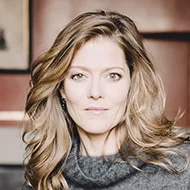
«I discover every piece I sing anew, no matter how often I have already performed it.»
Barbara Hannigan (b. 1971, Canada) is an internationally acclaimed soprano and conductor. She is one of the leading interpreters of contemporary music and works with the most important orchestras and opera houses in the world. Alongside her successful career as a singer, she has also established herself as a conductor and is committed to supporting young musical talents. She has been honoured with numerous international awards for her artistic achievements.
You combine singing and conducting at the highest level – was there a moment in your career when you made a conscious decision to pursue both roles in parallel?
There was a moment in my career when I decided to take up conducting alongside a schedule that was, essentially, already fully booked as a singer. And that was shortly after my conducting debut in 2011. The conducting debut was not a decision I made to steer my career in that direction. It was simply an event I wanted to try, an experience I had to have. And it took place in a fairly public setting, namely at the Châtelet in Paris, at the Présences Festival. It was only shortly before I went on stage for that event that I realised conducting would probably take up a large part of my attention in the coming year and in the years that followed. And that is exactly what happened. After my conducting debut, the phone began to ring, and I was asked to design special programmes as singer and conductor, which I initially did. Over the months and years, I managed to reconcile my career as a solo singer in opera productions and in concert, and as a conductor, by putting together programmes in which I sang one or two pieces myself, surrounded by a purely instrumental repertoire that I conducted. A few years later, I put together programmes where I only conducted. And for the last seven or eight years, I have had the freedom to shape exactly what I want, whether conducting or singing or both. Fifteen years have now passed since my conducting debut, and I am very happy with the path my life has taken.
You are particularly known for contemporary music – what attracts you to it compared with the classical repertoire?
Contemporary music has fascinated me since childhood. I remember enjoying the sounds themselves and the development of sound and melody in unexpected ways. And since I had a very good ear and was very well trained in harmony, sight-singing and so on, I had, in a sense, a gift – a gift nurtured by training – which I developed further for the difficult, more demanding aspects of contemporary music. But I think the most important thing is that I have a passion for contemporary music, and I realised that this passion is something unique. So I turned this passion, combined with my abilities, into a kind of vocation, using the word "voca", meaning "called". I felt it was a kind of duty for me, since I had this inner passion for music, to spend much of my time supporting composers and performing the music of our time. That is not to say that I do not love classical music. I do (!!), and most of my programmes as a conductor are more classical than contemporary! But I try to maintain a balance, and fortunately, at this point in my career, I have the trust and the relationship with audiences everywhere, so that I can programme pieces that may be unknown to the public, and they still come to the concerts because they are curious. I believe they trust that everything I choose is, in my view, very worth hearing.
You work closely with living composers – what does the creative process actually look like?
Working with living composers is different for each individual composer. What interests me when choosing composers is their authenticity towards themselves. I do not want them to write something they believe will please the audience or me. I want them to write truly from their innermost being and from their own passion. That is why I do my best to support them, and our communication during the creation of a piece can in some cases be very intense, down to the choice of text and very concrete conversations about my voice before they begin writing. That was the case with Hans Abrahamsen.
In the case of George Benjamin, before he began writing the opera "Written on Skin", I sang at his home for hours and performed various pieces for him. He had seen me perform many times and really insisted that he must write this piece especially for my voice. Other composers, such as Laura Bowler, who has just written "The White Book" for me, have followed my career and the projects I was working on for many years. From the very first moment we met, there was a very strong bond of trust between us. So we had no meetings where I made suggestions. I simply received this absolutely beautiful vocal line and score for "The White Book" when the work was more or less finished. And it is an incredible piece that fits me like a glove, and I can hardly wait to perform it everywhere!
How do you approach the interpretation of a completely new work that has no established performance tradition?
I love working on a new piece of music for which there is no recording yet, a piece that no one has yet seen, touched or performed. For me, that is a kind of golden ticket. I often compare it to leaving the first footprints in freshly fallen snow. For me, that is an adventure. I do everything I can to understand the composer's intentions, and also to make sure that, as an interpreter, I discover and open up new possibilities within myself, whether I am singing the piece, conducting it or doing both. That is how I approach a new score. For me, it is an extraordinary gift.
Is there a piece that you keep rediscovering even though you have sung it many times?
Actually, I rediscover every piece I sing, no matter how often I have already performed it. Whether it is an older work or something written for me – I approach every rehearsal and indeed every performance as if I were starting from a blank sheet of paper. And of course that is impossible when we have a memory and many performances and experiences behind us. But I keep calling to mind the image of the blank sheet of paper, and I have even gone so far as to stick a white sheet of paper to the mirror in my dressing room, to remind myself how important it is not to cling to things that may have gone very well, or to things that may not have gone so well at earlier performances or rehearsals, and to remain in a constant state of renewal and discovery.
How do you manage to find a balance on stage between vocal control and emotional freedom?
I make a very clear agreement with myself as a singer and actress, and this relates to your question about vocal control and emotional control, because many of the roles I sing are extremely emotional. For example, Poulenc's "La Voix humaine", the solo opera – it is so demanding, and the woman goes through such a traumatic and emotional journey, that the body can become very tense. When someone is close to tears, in real life the throat naturally tightens, and we are almost unable to speak. Well, as a singer, I cannot allow that. After all, I still have to sing a magnificent high C in the middle of the piece. So I make a deal with myself: the actress may play the role, but Barbara's voice must be protected – it is a kind of conscious play and an agreement. It is, so to speak, a playful arrangement between the two of them, so that I come out of performances of particularly emotionally demanding pieces unharmed vocally.
What have you learned from conducting about singing – and vice versa?
The most important connection between singing and conducting is breath. And as a singer I know: when I have worked with conductors who truly breathed well, I could sing better, because they were with me in the line and in the phrase. This is something I bring to orchestras as a conductor. I have even given masterclasses on breathing with some of the orchestras I work with, because it helps all of us, including the players of string instruments or percussion. Breath is extremely important as the foundation of our melodic line and phrase. So I would say that this is the most important connection: breath.
What qualities do you particularly value in orchestral musicians, and which in directors?
I love working with orchestras that communicate with one another, so that they are very cooperative within the orchestra. I love orchestras that are open to trying new things and taking risks. And I basically have this experience with all the orchestras I work with, I must say. And with directors – I assume you mean theatre directors. There are certain directors with whom I work again and again. These are Katie Mitchell and Krzysztof Warlikowski, as well as Andreas Kriegenburg. I would say these are the three most important directors with whom I have worked more than once, and I am very much looking forward to realising another project with the extraordinary Romeo Castellucci, with whom I worked last year, as well as with Christoph Marthaler, with whom I worked some time ago, but would very much like to work with again. I believe all these directors allow the performers to contribute to varying degrees. I think Katie Mitchell determines the most in advance for her actors what will happen. With Warlikowski, on the other hand, we work a lot with improvisation, and the same goes for Christoph Marthaler. In the case of Romeo Castellucci, he worked with me and Jakub Orliński on Pergolesi's "Stabat Mater", and we contributed quite a lot through movement improvisation, since both Jakub and I are very strong in movement; Romeo then shaped it the way he wanted and guided us – it was a very unique and enriching exchange.
Are there projects or roles that you deliberately turned down – and why?
Yes, there are some projects or roles that I turned down simply because I felt the vocal material might be too demanding for me, or because the combination did not suit me. I mean, of course I have to decline many things because I am not available and so on. And I have to choose what I do. That is why I am very careful. Usually it comes down to an instinctive feeling. Is this the right thing for me at the moment? Can I add something to this music that benefits the piece?
What are your passions outside music?
Being in nature, spending time with my cats and cooking.
What prompted you to record the programme of your new release "An American Dream"?
The development of American music has always fascinated me. The first half of the 20th century in particular was, in my view, an extremely fertile period in America. Jazz, Broadway, ragtime, folk music, but also composers such as Aaron Copland, who sought to find their own voice through disciplined training with teachers such as Nadia Boulanger in Paris, and then returned to America to truly write something they could define as a genuinely American sound – which, in my view, we have certainly found in the music of Aaron Copland. Of course, jazz and Broadway play a major role on this album, with the "Carousel Waltz", with "Porgy and Bess" and with the suite that Bill Elliott and I composed. I also wanted to address the theme of nostalgia and take a somewhat melancholic look at what has become of the idea of the American dream, and to question the America-centred behaviour of this country, and to ask why it often seems more dystopian than idyllic to many people. The album therefore above all raises questions, which is why the album's title contains a question mark. I give no answers, but I certainly ask many questions.
Interview by Florian Schär | Classicpoint.net | 01.07.2026
Image copyright: Marco Borggreve
More interviews
All interviews →


