

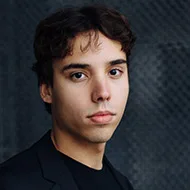
«Bach's music means everything to me.»

The Finnish-Cuban pianist Anton Mejias, born in Helsinki in 2001, has been described by the Finnish newspaper Aamulehti as a pianist whose „most exquisite quality… is his ability to enter into the music and create his very own sound world“. He made his recital debut at the age of eight and has been praised by press and audiences for his performances in piano recitals and with orchestras around the world.
Even at a young age, Anton Mejias was inspired and fascinated by the music of J.S. Bach. At the age of ten, he learnt the entire Well-Tempered Clavier, Book I. Since then, he has added the complete French and English Suites, all six Partitas and the Well-Tempered Clavier, Book II, to his repertoire.
You were born in Helsinki and have Cuban roots. What does home mean to you?
For me, Helsinki is my home. There was a time when I studied at the Curtis Institute of Music in Philadelphia, and I began to feel at home there too. But now Helsinki is definitely my home. I would like to move to Germany one day, perhaps, and I hope that in ten years' time I will be able to call another city my home too. I have Cuban roots on my mother's side – her father is a Cuban engineer who worked in the Soviet Union in the 1960s, where he met my grandmother. My mother was born in Minsk, and then they moved back to Havana together. One of my dreams is to play in Havana one day! Later, my mother went to Russia to study, from where she came to Finland and met my father.
How did you start playing the piano?
My parents are both musicians: my mother is a pianist and my father a jazz saxophonist. Music was therefore an integral part of our family life, and so it was quite natural for me to start playing. I showed a great interest in playing the piano from a very early age, especially Bach – I was five years old when I started lessons. Polyphony has always moved me very deeply.
At the age of 10 you had learnt the entire Well-Tempered Clavier I. What does Bach's music mean to you?
Bach's music means everything to me. And when I say everything, I really mean everything. For an almost mystical reason, I feel incredibly drawn to his music. Somehow he awakens in me the deepest emotions that I otherwise do not feel. Only through his music are these deep corners of my personal humanity activated. When I was little, I also sang in a boys' choir. The choir is called Cantores Minores. With CM we performed all these great works by Bach, the St Matthew Passion, the Christmas Oratorio, the St John Passion and the B minor Mass. I also believe that singing these works and physically resonating with the music through singing have greatly shaped my inner voice. I am firmly convinced that singing played a decisive role in my development as a musician.
What would you ask J. S. Bach if he were still alive?
If he were still alive? He is very much alive! His soul lives on in his music, and his soul resonates in countless artists who play his music. Every time one takes his music into oneself, he awakens to life again!
I don't actually think I would have a question I would want to ask him. I doubt that his genius can be expressed in words. I would simply like to follow him and see how he lives his life. Of course I would like to observe his compositional process, but I would also be very interested in the 'insignificant' everyday things he does in his life.
You have just released your debut solo album on Deutsche Grammophon, which includes the world premiere of Philip Lasser's „Twelve Preludes: The Art of Memory”, a counterpart to the second book of J. S. Bach's „The Well-Tempered Clavier”. It is a bold live recording. Why did you decide on a live recording?
Actually, it was not my decision to record the album live; I would have preferred the studio. But I quickly began to appreciate the idea of a live recording, and there are so many wonderful things about live recordings. It is a unique concert experience captured on tape. You can feel the energy of the audience passing through me into the music. This is something that is often missing from studio recordings. Of course I was afraid of the live recording, but now I would probably prefer to record live rather than in the studio. My experience of live recording was truly wonderful. Also, I was very expressive on stage; every note was a matter of life and death, since it was a live recording. I doubt this would have been the case with a studio recording.
How did you come up with the idea of combining these two composers?
It was actually my (very unusual) manager, Tanja Dorn, who first suggested this. I trusted her judgement and met Philip in Philadelphia while I was still studying at Curtis. Philip's music is otherworldly, and he has also influenced me greatly as a Bach interpreter. It was not only his own wonderful music that convinced me, but also his profound understanding of Bach. He gave me very original ideas for almost every prelude and fugue from WTC II, which further deepened my understanding of Bach. Philip and I speak the same musical language. I knew that his music would not detract from Bach's music, quite the contrary. It complements Bach's music in a very unique way and somehow makes Bach (I don't know how this is possible) a little more alive.
Were you involved in any way in the creation of Lasser's work?
Only very little. Philip was very inspired by his work, so that some of his preludes, in my opinion, became a little too long to complement Bach. He was, however, very flexible (which is rather atypical for composers), and we agreed very quickly. However, I had absolutely nothing to do with the musical content.
Can you tell us something about Lasser's compositional technique?
Philip has a very well-developed sense of structure and beauty in music. He understands Bach's works like no one else. And one sees and hears this in his music. His compositions not only evoke harmonic memories of Bach himself, but the structures of his preludes also complement the structures of Bach.
You are still young – what are your plans for the future?
Well, I have planned some wonderful concerts for the autumn, for example Bach's French Suites at the Tonhalle Zürich and Brahms's Piano Concerto No. 1 in Toulouse. These are just a few highlights of the coming season. As for the more distant future, I simply want to work with music, and then I am happy. It is as simple as that.
What are your passions besides music?
I enjoy reading very much. I especially love Hermann Hesse, and I am also very interested in Carl Gustav Jung. Recently I have also been reading Gardiner's „Music in the Castle of Heaven” (I'm not finished yet), and it is a very interesting book. I also like sport, for example swimming and football. Recently I have also started playing tennis and I enjoy every second of it. I'm not very good at it yet, but I have my whole life to get better.
Interview by Florian Schär | Classicpoint.net | 1 September 2025
© Image: Jiyang Chen