

«I am against dogma in art.»

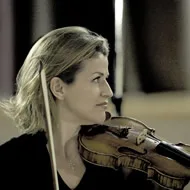
For 35 years, Anne-Sophie Mutter has been among the great violin virtuosos of our time. The violinist, born in Rheinfelden in Baden, began her international career in 1976 at the Lucerne Festival. A year later she performed as a soloist at the Salzburg Whitsun Concerts under the direction of Herbert von Karajan. Since then, Anne-Sophie Mutter has performed worldwide in all the major musical centres.
Classicpoint.ch: What are your earliest memories of playing the violin?
The first impression was conveyed to me by an LP recording of Menuhin's Beethoven Concerto. My earliest memory of actively playing the violin is in fact my first lesson, which must have taken place sometime in 1968/69. It spontaneously felt symbiotic, as if the violin had always been resting on my shoulder.
You originally studied at the Winterthur Conservatory in Switzerland and experienced the start of your international career at the Lucerne Festival. What are your memories of your training years, and what is your relationship with Switzerland today?
My relationship with Switzerland could not be more intense, as I was able to study there from the age of nine at the Winterthur Conservatory with the wonderful Aida Stucki. Incidentally, Alemannic – my mother tongue – is very closely related to Swiss German. Moreover, my debut in 1976 at what was then the International Music Festival Weeks in Lucerne naturally played a large part in my international career.
I always return to Switzerland with pleasure. Especially to the Lucerne Festival Weeks, though.
You made your debut under the direction of Herbert von Karajan at the age of 13. Were there moments in your youth when you would gladly have exchanged the pressure of expectation and fame for a carefree youth?
Neither during my teenage years nor looking back did I have the impression of having lived a troubled youth. I was completely absorbed in music, and being allowed to perform with Herbert von Karajan and other great musicians was my everything and thus the central focus of my years of learning and wandering.
You have founded your own foundation to support outstanding young musical talent. Do you believe all of your scholarship holders are capable of a world career? What is ultimately decisive for a breakthrough?
In supporting outstanding young musical talent, I am not primarily concerned with a world career. Apart from the passionate search for a talent who possesses an insatiable thirst for knowledge and burning convictions about musical literature, my main concern is to introduce young musicians to the humanistic side of musical life, to encourage them to build bridges with and through music and to engage socially, for example through charity concerts.
You often perform at charity concerts for institutions that address the medical and social problems of our time. Which projects/institutions are closest to your heart?
All the projects I have supported with heart, soul and concerts are particularly close to my heart. However, it is above all the concerns of children, elderly people and people with disabilities that repeatedly move me, trouble me and compel me to act.
Alongside Lynn Harrell, Aida Stucki, your longtime teacher, is a decision-maker in your foundation. How strongly has Aida Stucki shaped you, and what do you especially value in her?
There is nothing about Aida Stucki that I do not value. She is an extraordinary woman: musician, mother and educator. She shaped me early and most lastingly. Particularly worth highlighting is her remarkable ability to guide talents individually and with admirably patient strictness over a long period, and ultimately to bring them to full bloom.
In 2006, on the occasion of Mozart's 250th birthday, you recorded comprehensive recordings of Mozart's works for violin. What significance does the composer Mozart have for you compared with the other truly great composers?
Mozart, with his many wonderful chamber works as well as his violin concertos, occupies a special place in the repertoire of every violinist. Not only because of the unusual diversity and volume of the works, but also because of their singular purity of expression and the genius of their musical development.
What is your view on authentic or historically informed performance practice?
I am against dogma in art. An authentic performance practice cannot exist, but there can be an attempt to come close to the sound and phrasing of the time, and thus an extremely important part of analysis and of finding an interpretation in today's world.
You have been on stage for 35 years. Which were the most important impulses or events that have influenced your artistic development during this time?
No one lives in a vacuum, and no artist should. Personal experiences in my violin playing have repeatedly influenced, enriched and at times even shaken me profoundly, such as the loss of my husband, the father of my children, and the wonderful gift of the birth of our two children.
You engage intensively with contemporary music too. Several composers have written works for you, including Krzysztof Penderecki, Wolfgang Rihm and Sofia Gubaidulina. When did you first seriously engage with contemporary music?
Contemporary music is another important source of inspiration, as is the visual arts and simply life with its many diverse and truly wonderful moments. I have been engaged with contemporary music since the world premiere of Witold Lutosławski's “Chain II” on 31 January 1986. And the last few weeks and months have been filled with studying new works by Wolfgang Rihm and Penderecki, as well as a violin concerto by Sebastian Currier, which will receive its world premiere in New York this summer. It is an exciting process, a frustrating one, one that drains one's energy, and a profoundly fulfilling engagement with a new musical language and, finally, with a counterpart: the living composer, who answers questions.
You once said that you wanted to stop at the age of 45. Fortunately, that did not come true. Do you plan to leave the stage soon?
There is really only one answer to this question. It was John Lennon who said “Life is what happens to you while you're busy making other plans”, and so my last hour on stage will also strike at some point.
What are your plans for the future? Are there projects you are determined to realise?
There are many plans for the future, but I trust in God and therefore hope that the most important project, my greatest wish, will be fulfilled: to see my children growing towards their calling, happy and healthy.
Interview by Florian Schär | Classicpoint.ch | 24.04.2011
© Photo: Harald Hoffmann / DG