

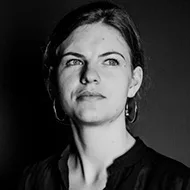
«I always search for emotions within myself.»

The conductor, born in Kraków, won the first prize at the «La Maestra» competition in Paris in March 2022. Since then she has performed regularly with all the major Polish orchestras and made debuts in the 2023/24 season with the Deutsches Symphonie-Orchester Berlin, the Orchestre National de Lille, the National Arts Centre Orchestra in Ottawa and the Philadelphia Orchestra. In the coming seasons she will make further debuts in North America and Europe. In 2023 she was awarded the Neeme Järvi Prize of the Gstaad Conducting Academy. The jury members were Jaap van Zweden, Mirga Gražinytė-Tyla and Johannes Schlaefli. Sułkowska-Migoń champions the works of Polish composers: in July 2023 she conducted a commemorative performance at the Oregon Bach Festival marking the 25th anniversary of the world premiere of Penderecki's Credo, and in April 2023 a special concert at the Teatr Wielki in Warsaw featuring works by Mieczysław Weinberg and Elżbieta Sikora, on the occasion of the 80th anniversary of the Warsaw Ghetto Uprising. Anna Sułkowska-Migoń is the recipient of the «Top Prize» within the Taki Alsop Conducting Fellowship 2022 to 2024. As an instrumentalist, she completed her master's degree specialising in viola at the Fryderyk Chopin University of Music in Warsaw and earned a further master's degree at the Krzysztof Penderecki Academy of Music in Kraków, where she specialised in orchestral and choral conducting.
You also enjoy conducting choirs and orchestras. How does one inspire the other?
Choir members use their voices, a natural instrument of the body, which creates a different kind of bond during the making of music, a relationship between the ensemble and the conductor. I must admit that I miss working regularly with choirs, including in the a cappella repertoire. The ability to breathe together with a choral ensemble certainly helps when working with an orchestra; on the other hand, the technical discipline of conducting an orchestra helps with the transparent direction of a choir. When we speak of mutual inspiration, we must not forget the text, which plays a role in choral practice. In this way the orchestra can convey the character of the music perfectly.
In your opinion, what is the greatest challenge for a female conductor?
I think it is worthwhile to be yourself, regardless of gender, and not to try to forcibly imitate others, even though it is difficult. From a woman's perspective, I can say that the challenge for me is to be a mother, wife, friend and conductor at the highest level. In every role I demand 100% of myself, and sometimes that is simply impossible. I keep getting to know myself anew, but I am glad to have such an opportunity and that more and more institutions are helping to combine a professional career with motherhood.
You were born in Kraków and are committed to the work of Polish composers. Is there a common denominator in contemporary compositions from Poland?
I always try to persuade the institution to present a Polish piece. I think the role of a guest conductor gains value even when we can present something new yet familiar. That is why I also suggest less well-known compositions by composers such as Mieczysław Karłowicz, Feliks Nowowiejski or Grażyna Bacewicz. Of course, I also gladly draw on the world-famous Polish repertoire (Fryderyk Chopin, Karol Szymanowski, Witold Lutosławski, Krzysztof Penderecki). In recent years I have discovered among young Polish composers an interest in the voice and in inspiration drawn from folk music.
You studied viola yourself. Do you still play today?
Unfortunately only very rarely; sometimes I play with my husband, but during holidays I plan to return to my favourite solo pieces from my student days.
You recently conducted the new production of the opera «Eugen Onegin» in Bern. What is it like to work with the Berner Symphonieorchester?
It was a fantastic experience. It is worth mentioning that while preparing the production I spent far more time with the soloists, the chorus, the director, the pianists and the members of the production who are not visible on stage, but whose work is extremely important. I remember our preparation period very well – full of respect, mutual support and a good atmosphere. With the orchestra the work goes much faster – it takes about a week, and the clarity of the conducting is important because the orchestra's line-up changes.
Why, in your opinion, are there so few female conductors?
It is a demanding profession that requires strong character, support, self-confidence and self-discipline, but it also involves frequent travel. Not everyone finds their way in it, although I do not feel that there are only a few female conductors. Certainly fewer than men, but the number of women in this profession grows with each year. For me it is important that a conductor is competent and good.
What are your musical goals and visions?
With every project I try to work on my conducting technique, I look for better solutions, I analyse my gestures in order to be as effective and helpful as possible, but I always search for emotions within myself and try to sing certain musical phrases; that is when I feel the music best. I do not want to lose that.
I find it hard to say where I see myself in ten years. We will see what time brings.
Is there a particular orchestra you would like to conduct, and why?
I have certain musical dreams, but I enjoy and value working with every orchestra.
What are your passions outside music?
There are many. I love travelling in unconventional ways – by kayak, by bicycle, in a tent. I enjoy being in nature and among people. I like spending time in our mountain hut, cooking and baking in my free time, reading books by the fireplace or simply lying in the grass gazing at the sky while listening to the sounds of nature. I regret that I no longer have time for scouting and tennis training, but it is time for new challenges.
Interview by Florian Schär | Classicpoint.net | 1 April 2025
© Image: Grzegorz Mart