

«I think social media, YouTube and streaming also put enormous pressure on young musicians.»
«I think social media, YouTube and streaming also put enormous pressure on young musicians.»
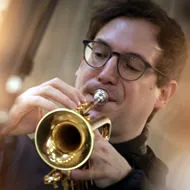
The bright sound and versatility of the trumpet have fascinated Andre Schoch from the very beginning. At the age of eight he received his first trumpet lessons from Ansgar Dümchen. From 2004 to 2007 he was a junior student of Reinhold Friedrich and Klaus Bräker at the Karlsruhe University of Music. He later studied with Matthias Höfs at the Hamburg University of Music and Theatre, where he also taught from 2015 to 2017.
At a young age he already gathered orchestral experience in the Baden-Württemberg State Youth Orchestra, the Junge Deutsche Philharmonie and the Schleswig-Holstein Music Festival Orchestra. His first engagement took him to the Gewandhausorchester Leipzig. There he was assistant principal trumpet from 2009 to 2011, before he received a scholarship at the Karajan Academy of the Berlin Philharmonic, where Gábor Tarkövi taught him. The musician found his time at this institution very valuable. "Experiencing the style and sound of the orchestra and fitting into it is extremely fulfilling and motivating." After positions as principal trumpet at the Deutsche Oper Berlin and the Hamburg State Philharmonic Orchestra, Andre Schoch became a member of the Berlin Philharmonic.
The multiple prize-winner of renowned competitions is also active in chamber music. He is a permanent member of the ensemble 10forBrass and a founding member of the SchwarzGoldTrio. He also regularly performs as a guest with German Brass.
You have just recorded your first solo album, featuring a demanding repertoire of Baroque and early Classical trumpet concertos. Have you been living with these works since childhood?
Yes, these works have been with me for a very long time. I started playing the trumpet at the age of 8 and, as a child, I always wished for recordings of famous trumpeters for Christmas and my birthday. Even back then I listened to exactly these works a great deal and set myself the goal of one day being able to play them too. A great motivation! During my studies I actually played these pieces for the first time and gradually found my own interpretation.
You perform these works on modern piccolo trumpets by the Bremen firm Thein Brass, in whose development you yourself took part. What is special about these instruments?
These piccolo trumpets have for me a particularly warm, yet also brilliant, very colourful sound. In addition, the quality of the instruments is unique, the intonation is very good and the playing feel is very free. Working with the firm Thein is very close to my heart, because as an artist you can incorporate your personal wishes and ideas, and these are realised with great love of music and craftsmanship by Thein. In this way the instruments are individually adapted to the respective player.
You were principal trumpet at the Deutsche Oper Berlin and the Hamburg State Philharmonic Orchestra, and you are now second trumpet with the Berlin Philharmonic. How did you experience this change?
First of all, I am very grateful to have been able to play in various orchestras and experience different ensembles, both in the symphonic field and in opera and ballet. I can also count myself fortunate to have experienced both principal positions and now the second trumpet position. Naturally, one has a different task: as second trumpeter you must adapt and fit in more, whereas as principal trumpeter you must lead the entire brass section and take charge. I am glad to know both, because that also helps me convey this better when teaching.
The Berlin Philharmonic is such a magnificent orchestra that it is very inspiring to play there, regardless of position.
You also teach. What are the biggest problems your students face?
Competition and the technical standard are enormously high today, and of course there are always very many applicants for orchestral auditions. I think social media, YouTube and streaming also increase the pressure on young musicians enormously compared with earlier times. That is why it is all the more important that young musicians are also mentally very well prepared and stable and broadly positioned in all areas. As a teacher, I try to support them, to motivate them to keep working and not to give up when something does not go as smoothly as expected.
Is there actually a particular type of person who suits the trumpet best?
That cannot be said in such general terms. However, love of the instrument is the most important thing. And for us trumpeters, perhaps a certain courage and a certain determination are part of it when we present ourselves on stage, since the trumpet is a very "honest" instrument and now and then the so-called famous "clam" can happen, which everyone then hears. It is important to learn not to be unsettled by this and to shake it off quickly.
Singers are well known to be constantly concerned with protecting their voices, and some go around permanently wearing a scarf. What is important for trumpeters?
For us trumpeters it is important to look after our lips a little, that is, not to let them dry out, for example when it is very cold outside in winter. Otherwise it is only important to take a little care of one's teeth, since the alignment of the teeth plays a major role for us.
Are there particular moments in your career on stage that you will never forget?
Once I played a concert with a brass ensemble in Madagascar for orphaned children. I have never before experienced how emotionally and with what enthusiasm these children responded to music. It was extremely moving to see and will always stay in my memory.
How much do you still practise every day?
I spend several hours a day on the instrument and with music. I do not time it, but it is certainly some hours a day…
Do you have further projects planned for the future?
First of all, I look forward to presenting the programme of the CD even more on the concert stage.
In addition, I have regular chamber music projects, other projects as soloist with orchestra, as well as with organ.
Several projects are also planned to record works by some almost forgotten composers, as well as projects with contemporary composers.
What interests do you have besides music?
Besides music, I enjoy time with my family, watch good films and love good food.
Interview by Florian Schär | Classicpoint.net | 01.12.2023
Photo: Yoél Culiner