

« Nobody eats three main courses. »
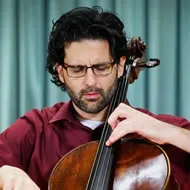
The Grammy-nominated cellist, conductor and pedagogue Amit Peled enjoys a busy and dynamic career before audiences around the world. The founder and artistic director of the Mount Vernon Virtuosi combines a growing conducting commitment not only with a successful solo career on the ex-Casals Goffriller cello of 1733, which Marta Casals Istomin personally handed over to him, but also with a professorship at the Peabody Institute of Johns Hopkins University in Baltimore, USA. In his continuous endeavour to make classical music more accessible, he has recently published the children's book "A Cello Named Pablo" as well as the cello technique workbook "The First Hour".
Classicpoint.net: How did you come to the cello?
I grew up in a small kibbutz in Israel, and in fourth grade we were all "forced" to learn an instrument. As a basketball player, that was the last thing I wanted to do. Luckily, there was a girl four years older than me who played the cello. I had fallen in love with her and thought that the only way to get closer to her was to play the same instrument as she did, and that one day we would get married. Of course, nothing of the sort happened, except that I am now a cellist!
You began your studies with Bernhard Greenhouse of the Beaux Arts Trio. Could you tell us about that?
Since my youth in Israel, it had been my dream to meet Greenhouse and hear his legendary sound. Together with his teacher Pablo Casals, no cellist influenced my sound as much as Greenhouse did. When I then had the chance to live next to him in his picturesque retirement village in Cape Cod and study intensively with him for three years, I seized it with both hands. It was the most significant training for me as a musician and as a person. Greenhouse himself had been looked after in this way by Casals in the 1940s, and it was natural for him to pass [this care] on to younger musicians.
Why did you move to Germany afterwards?
The first reason was my girlfriend at the time, now my wife, Julia, who was studying in Berlin. But when I moved to this artistic centre in Europe, I was lucky enough to be invited to study with the Russian cellist Boris Pergamenschikow. The two years with him were the "cherry on the whipped cream" of my training. In Boris I found the unique combination of a very special person and truly phenomenal cellist, and the rare opportunity to share all of these qualities in one teacher.
You started teaching early on. What appeals to you about it?
I had so many wonderful mentors that it was natural for me, and also very important, to pass on all the knowledge I had received from my teachers over the years, combined with my own way of dealing with students. As Janos Starker said: "I cannot play without teaching, and I cannot teach without playing." That embodies who I really am as a musician.
You play one of the most famous instruments in the world, the Gofriller cello of Pablo Casals. How did you acquire this instrument?
About seven years ago I played for Mrs Casals, who was in her eighties at the time. It was a good opportunity to get to know her, and I was very grateful to receive this chance. I began with Bach, and it turned into a lesson. She gave me a great many comments and asked me to keep playing. I played Dvořák, Brahms and more. She told me that she had not closed her ears while I played (she said she often does that when listening to younger players). After an hour, she suggested that we have a glass of wine together. She told me that she owned Casals' cello and invited me to come back another time to play it. About two months later I returned to play this incredible Gofriller of Pablo Casals. It was like waking an old person who is sleeping peacefully. The cello was not very responsive at first, but I was in heaven: I was allowed to touch my hero's cello! A few weeks later she lent me this instrument so that I could share it with people all over the world.
Did you ever have nightmares that something might happen to the instrument?
No, in the end a cello is a tool, and as such you have to work with it. After a short time the cello became a part of me, and as such I have looked after it ever since.
You were a promising basketball talent and had to choose between a professional basketball career and a career as a musician. What was ultimately the decisive factor for you?
In the kibbutz in Israel I spent most of my time outdoors doing sport; basketball soon became second nature to me. I was very good and saw a future as a professional. But fate had a different plan: my teacher told me that I had to choose one of the two, and I chose the cello, without knowing that one day I would be 1.95 m tall!
Looking back, would you make the same decision again?
Probably yes, but with the perspective I have now after many years, I know that this decision was made for me by forces more powerful than myself. One could call it fate.
How do you pursue your passion for sport today?
I watch as much NBA as possible with my children, and from time to time we also go to NBA games, and of course I have become a big fan of our local team, the Baltimore Ravens.
You have already tried to combine these two worlds in projects. Could you tell us more about that?
Yes, I have already given several concert lectures in which I demonstrated the connection between body and mind, and the aspect of communication that one needs both for playing basketball and for playing together with other musicians. Apart from the vast difference in salary, of course…
It is very important to you to make classical music accessible to a large audience. What are your aspirations?
This is something I think about often, and so far I have found two approaches for myself. On the one hand, I talk to my audience during the concert. I introduce the pieces I play, tell anecdotes, and connect with the audience through current local events.
In addition, I try to lighten the programme a little. It is like a good dinner: you have a starter, a main course and a dessert. Nobody eats three main courses; that would be far too one-sided and heavy. The same applies to concert programmes: playing three large sonatas is too much, so I play one major piece and surround it with smaller, entertaining pieces.
I have also published a children's book, "A Cello Named Pablo", and what I love most about it is reading it to children. I have already done this at a few schools, and it is wonderful to see how they enjoy hearing the story and then also seeing the cello. Two weeks ago I played at a school in Seattle, and one of the children asked me: "Is Pablo really alive?" And I said: "Of course he is! I believe that he lives, what do you think?" And he said: "Yes, he lives!" That was fantastic for me!
What are your future projects?
After twenty years of intensive cello playing and travelling, I have revived an old passion of mine: conducting. In this way I can give something back to my community and also train a larger number of musicians in my orchestra. Founding the Mount Vernon Virtuosi in Maryland has been one of the greatest musical joys of my career, and I look forward to combining my solo career more and more with my life as a conductor.
Interview by Florian Schär | Classicpoint.net | 1.4.2019
More interviews
All interviews →


