

«He was someone very dear to me.»

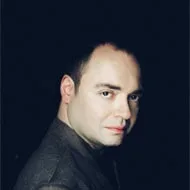
Alexander Melnikov completed his studies at the Moscow Conservatory with Lev Naumov.
Among the most formative experiences in his musical life were his encounters with Sviatoslav Richter, who regularly invited him to his festivals in Russia and France. He is a prize-winner of major competitions such as the International Robert Schumann Competition (1989) and the Concours Musical Reine Elisabeth in Brussels (1991).
His musical and programmatic decisions are often unconventional.
Very early on, Alexander Melnikov began to engage with historically informed performance practice. He received essential impulses from Andreas Staier and from Alexei Lubimov, with whom he has collaborated on numerous projects. He regularly performs on stage with renowned early music ensembles such as the Freiburger Barockorchester, Musica Aeterna, the Akademie für Alte Musik Berlin and the Orchestre des Champs-Élysées.
You first learned the horn and only later became enthusiastic about the piano. Why did you change your mind?
I heard the sound of the horn for the first time shortly after my conception – about seven months before my birth. As I was then an avid follower of the Sigmund Freud concept, I was immediately taken with the round shape of the instrument, which evoked all sorts of connotations – to mention some of them would be out of place in this interview. The second decisive factor came at the age of 3, when I saw a postman. In the Soviet Union the post office was forbidden to put a horn on its logo – Freud did not get along well with communist ideology – so every postman had to carry his own horn at all times. Of course, the horns were mainly used as vessels for vodka, but sometimes they drank the breaking liquid instead – one simply HAD to hear how wonderfully it sounded – those times are indeed over.
Finally, it had always been my dream to play Beethoven's 23rd Horn Concerto and, above all, the fantastic horn solo in Debussy's "Moldau Overture".
You are regarded as a virtuoso interpreter of Shostakovich. What does this music and this composer mean to you?
It is completely impossible to answer this in a way that would make sense... I have been occupied with his music for a long time, and my standpoint has changed several times, but always towards a greater appreciation. He was a figure about whom people will always argue. Too many musical, social, human and philosophical layers intertwine and sometimes contradict one another. I only know that he was someone very dear to me, and an absolutely indispensable part of my being. The rest – I cannot say that outside of playing or listening to the music itself.
You engaged with historically informed performance practice very early on. What fascinates you about it?
It is true, I have been influenced and fascinated by old instruments for a very long time. I am by no means a specialist in early music – but I engage quite intensively with old pianos, and of course I also play them. It has also led me to see the phenomena of the "modern" piano in their historical context – and that changes things...
This year you recorded a CD with Isabelle Faust, bringing Mozart's "Sonatas for Piano with Violin Accompaniment" back to life. Can you tell us something about it?
Well, that was already CD number 3... What can I say about it? That this music is as good as Mozart's music gets, often almost even more fascinating to me than the solo piano sonatas, and that I have the incredible good fortune of playing it with Isabelle. It is also one of the most difficult projects I have ever undertaken – partly because there are too many occasions where one can no longer ignore or avoid questions of ornamentation and improvisation, and whatever one does in this music – one destroys perfection. This is not a hypothetical or spiritual remark, but purely practical. Try to imagine a painting by Rembrandt in which he had left some parts empty so that we could complete it – good luck.
You are currently working on your project "Many Pianos". Can you tell us about it?
Well, I have two different versions of this programme. One – recorded on CD – consists of four highly virtuosic works, all symbolic of a certain era, played on a contemporary instrument. The idea is to place them in the sound context that is more willing to highlight certain aspects of this music, which are often lost.
Another version is the elaboration of the genre "Fantasia". Here the aim is to show how gradually the development of the musical language took place and how closely it was connected with the development of the medium – of the instrument.
How have you experienced the current COVID period?
Just as with the mortality rate, we will answer these questions only once the pandemic is over. Unfortunately, the end is not in sight for now. What is certain – things are changing. If we succeed in turning some of these changes for the better, we will be very happy. But I am not too optimistic here.
What do you wish for the future?
That is very private. But I would be very pleased if our civilisation developed a little better. But here, too, I am not too optimistic.
What was your funniest experience as a musician?
Many years ago, alone in the 8 bars of the second movement of Ravel's Violin Sonata "Blues", I watched how many things can go wrong.
Do you ever feel fear as a musician?
Yes, very often before concerts. But not always.
You have a second great passion: you are a (hobby) pilot. How did that come about, and where and why do you fly?
Well, strictly speaking, it is no longer a hobby. But I can say with certainty that I did not diversify successfully – demand for pilots is now the same as demand for performing musicians – more or less zero.
Interview by Florian Schär | Classicpoint.net | 22.10.2020
More interviews
All interviews →


