

Dresdner Philharmonie
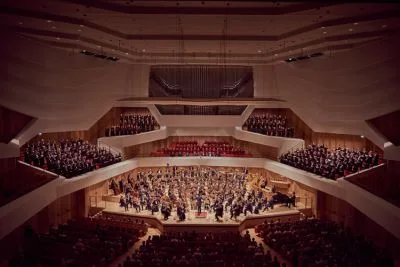
The Dresdner Philharmonie looks back on 150 years of history as the orchestra of the state capital Dresden. With the opening of the so-called Gewerbehaussaal on 29 November 1870, the citizens gained the opportunity to organise large orchestral concerts. From 1885 onwards, philharmonic concerts were held regularly until the orchestra adopted its present name in 1923. In the first decades, composers such as Brahms, Tchaikovsky, Dvořák and Strauss conducted the Dresdner Philharmonie with their own works. Outstanding leaders such as Stefan Frenkel, Simon Goldberg, and the cellists Stefan Auber and Enrico Mainardi played in the orchestra. Carl Schuricht and Paul van Kempen led the orchestra from 1934; van Kempen in particular brought the Dresdner Philharmonie to outstanding achievements. The strong focus he placed on the music of Anton Bruckner in his programmes earned the orchestra the reputation of a "Bruckner orchestra". Among the distinguished guest conductors who came to the Philharmonie at that time were Hermann Abendroth, Eduard van Beinum, Fritz Busch, Eugen Jochum, Joseph Keilberth, Erich Kleiber, Hans Knappertsbusch and Franz Konwitschny, who also conducted the Dresdner Philharmonie.
After 1945, up until the 1990s, Heinz Bongartz, Horst Förster, Kurt Masur (also honorary conductor since 1994), Günther Herbig, Herbert Kegel, Jörg-Peter Weigle and Michel Plasson served as chief conductors. More recently, conductors such as Marek Janowski, Rafael Frühbeck de Burgos and Michael Sanderling have shaped the orchestra. At the start of the 2019/2020 season, Marek Janowski returned to the Dresdner Philharmonie once more as chief conductor and artistic director.
Its home is the state-of-the-art concert hall opened in April 2017 in the Kulturpalast in the heart of the Old Town. In the Romantic repertoire, the orchestra has preserved a distinctive "Dresden sound" of its own. Beyond that, it is distinguished by its flexibility of sound and style, both for the music of the Baroque and the Viennese Classical period and for modern works.
To this day, world premieres play an important role in the orchestra's programmes. Guest appearances in the major concert halls around the world bear witness to the high esteem the Dresdner Philharmonie enjoys in the classical music world. Education and family formats with top-class casting complement the offering for young people; through rehearsal visits and school concerts, even the youngest concertgoers are introduced to the world of classical music. The orchestra nurtures top young talent at the Kurt Masur Akademie.